OR
Why Quality Salt Is Healthier Than Shitty Sugar
 |
| Source |
Iodine is - brace yourselves, I consulted my textbook for this - a poisonous gas that we need to ingest. A halogen mineral, it sits comfortably in the 53rd spot of the Periodic Table, and is apparently purple, not that we ever get to see it. It's most commonly found in vegetables and mixed in with table salt, or salt in general, which is why folks who live in places like Halifax don't have problems with goiter; the sea breezes blow enough iodine into our systems that our thyroid gland doesn't have to expand to try to catch more. (For those of you wondering what goiter is, think of the guy in Disney's Tangled with the winged helmet.) While Iodine in its natural gaseous form is terrible for us, iodine in food is a natural substance that we need to function correctly. This is also true of the salt in which it's found. As much as it's not super great for your blood pressure, without it you would absolutely die. Salt is so necessary that in ancient civilizations it could be traded as currency and people would get arrested for boiling saltwater at home instead of buying it. It's a big deal.
My Daddy recently read and recommended a book called Wheat Belly by William Davis, and has been following the author's guidelines for getting rid of his persistent "beer belly", which I'm very proud of him for. Mr Davis believes that because wheat grown today is so far removed from the wheat that folks in the fifties and earlier had that our bodies have no idea what to do with it. Genetically engineered and cross-bred to be uniform heights, grow at specific times, and taste a specific way, as well as survive frost and pests, the wheat plants we eat in pretty much everything are not only a threat to those with gluten intolerance and Celiac Disease, but everyone else, too. I've been mostly following in my father's footsteps as of the last week or so after finishing a school project and realizing maybe wheat wasn't the best for me, either - albeit for a different reason.
This past Thursday I'd asked my teacher which was worse: salt or sugar. We'd been talking about atherosclerosis, the hardening and thickening of arteries in the body, and how the amount of salt someone eats can alter how bad their situation is. The class before, we'd talked about how sugar in high amounts, especially high fructose corn syrup, was causing ridiculous quantities of children in the United States to develop or be born with type two diabetes. Obviously neither salt nor sugar are great for you in large amounts, but it seemed, to me, that sugar was the baddest baddie of the two. It makes us fat, attention-deficit and hyper, lethargic, blocks absorption of vitamins we need to live (like vitamin C; those with compromised immune systems should really avoid it), inflames the body, is addictive, severely screws with our insulin levels, and tastes so damn good we can't stop eating it. Salt, on the other hand, keeps us balanced in more ways than one. It helps our bodies build hydrochloric acid in our stomachs to break down food, aids in blood sugar controls, and supports our thyroid gland. This being said, the thousands of grams of cheap, white, refined salt that live in prepackaged meals and your cute bottle of table salt aren't helping you at all. On the contrary, they're making you sick.
 Anytime I've ever heard the term "food diary" I've gotten annoyed. Those two words ring out at me from every television show, healthily living book, and style magazine available, all aimed at women trying to lose weight - keep a food diary, they say, and you'll eat better! Or less! Or you'll just feel ridiculously guilty and
ashamed and stressed out, says I. Tedious and over-analyzed, the whole concept seemed pointless to me. But despite my loathing for the practice, I was assigned a project for school that told me to do just what I'd never wanted to: keep a food log. For five days I had to plug in exactly what I was eating and at what time (although thankfully without note of calories), how much water I drank, how I felt, and how many times the toilet and I made conversation. Afterwards, it was my responsibility to look over the information from an outsider's point of view and make recommendations to the "client" on how to eat healthier.
One of the most frustrating questions vegetarians of any kind get asked is, "Where do you get your protein?" Although this macro-nutrient comprises 20% of our body and is needed for everything from muscle building to brain power, it's considered the most important thing we ingest beyond calories by most people. Never mind that your body needs good carbohydrates and fats to function well too, no, the question is always, "How much protein are you eating? Are you pregnant? Are you trying to build muscle? Are you old? More protein! Eat your lean chicken!" Becoming a vegetarian at age fourteen opened me up to years of this question and insists that I eat more beans. Confirmations that yes, a person can get plenty of protein from plant foods were always met with hesitant, "Okay..."s and disbelieving looks. If you know a vegetarian or vegan, please refrain from asking this question, as well as the, "But if you were trapped on a desert island with only a cow to eat...?" one. Just stop.
It was, therefore, the most grueling self-acceptance of mine that I realized, upon finishing my food diary report, that I was severely lacking in protein. In the span of a week I'd eaten nothing but sunflower seeds that were specifically, predominantly protein. Suddenly the suspicious muscle loss and slower cognitive function I'd been experiencing made perfect sense, especially when paired up with the realization that I live almost entirely off of sugar and simple carbohydrates, and had been following this pattern for years. No wonder I'm hungry all the time.
Most anybody can recognize plain white sugar. Hand someone a chocolate bar and they'll easily confirm that it's loaded with the stuff. Fruit, most people can tell, has its own natural sweeteners. But when handed a box of pasta, nobody looks beyond the nutrition facts on the side that say how many carbohydrates are inside and wonders what that pasta will become once they ingest it. When we eat the three main macro-nutrients, carbohydrates, fats, and proteins, our body takes them apart like Lego and then build them into things our
bodies need to function. Fats... well, they stay as fat, and lubricate our cells, move fat-soluble vitamins around, and pad up our internal organs so we don't die of cold or shock. Protein is deconstructed into amino acids when we eat it, little building blocks that construct everything from stretchy muscles to serotonin. Anything solid besides bones in these meat sacks we call bodies is made of protein. Carbs, on the other hand, are our main source of energy. Our bodies run on glucose, a form of sugar. Carbohydrates, both complex like buckwheat and simple like pasta, turn into glucose. Carbohydrates are sugar.
The reason low-carb diets "work" is because our bodies, when they can't find sugars in our diet, will pull stored sugar, sitting in fatty deposits (your favourite love handles) out of our bodies to burn for fuel. Once those are gone, your brain instructs your digestive tract to start eating protein, our emergency rations. This is called ketosis, and although Mr Atkins thinks it's a great idea, it's dangerous and ensures that when you do reintroduce carbohydrates, your body's going to hold on to those sugars, in the form of fat, like a starving man would a banquet. The fact is, we all need carbohydrates to function right. It's the cheap firewood that keeps us running. Cutting out carbs is like throwing electronics in the fire to avoid burning up wood. Electronics don't burn well, aren't good to be breathing in, and cost a lot more than a chunk of dead tree. Plus the fire'll be pretty weak by the time you decide maybe it's okay to use firewood again. Let's just do ourselves all a big favour and not avoid carbs, alright?
Carbs come in a couple forms. Simple sugars are pasta, white rice, bread, basically anything that makes you feel good eating when you're stressed out. Complex carbs are buckwheat, quinoa, brown rice, beans, things that make it too hard for you to have dessert because you're so full. At the risk of getting too technical, simple sugars are little chains, and complex are long chains. If you had a couple jelly beans in one hand and a foot-long Fruit Roll-up in the other, which would take longer to eat? These long-chain "Fruit Roll-up" complex carbs are a slow form of sugar that your body can still use well but that don't cause blood sugar spikes or contain so many simple "jelly beans" that they get out of hand and your stomach has to time-out them in fatty deposit corners. Basically, if you've got problems - like me - with eating too much sugar, opting out of the Halloween candy isn't good enough. You've got to get rid of the simple carbohydrates and replace them - to avoid ketosis - with complex. The bonus of complex carbs, especially for those of you worried about their vegan family members, is that they contain protein. I've been opting out of eating wheat - which is generally a simple carbohydrate, unless you're eating wheat berries - and these "jelly beans" in general both to stabilize my blood sugar, increase my protein intake, and help satisfy my unending hunger.
Here we arrive at the point of this post. Salt. Once you cut that delicious sugar out of your diet, and being as everyone and their mom's telling you you need to stop eating salt, food's probably going to look pretty bland. I have bad news for you: you should probably cut down on the salt intake, and you have to stop buying regular old table salt. The good news is, you don't have to get rid of salt completely.
Consider where salt comes from. The sea, the earth, the human body. The table salt we're all used to eating comes from one of these sources (hopefully not the last one, haha), gets sent to a factory, and then is bleached, depleted, de-ionized, sprayed with chemicals, sprinkled with iodine, rolled in sugar, and packaged in pretty white bags. You read that right. Go grab the salt from your baking cupboard right now - there's sugar in it.
Obviously when your salt has sugar, your body's more than a little confused and you're eating something very unnatural. The general goal of someone who wants to be healthy should be to eat as close to a food's traditional form as possible, meaning they'd opt for a steak, which is just a hunk of muscle, instead of a hot dog made of mysterious beef parts mixed with chemicals and wrapped in plastic. Seasonings should be looked at the same way. If you went down to the beach, grabbed a cup of seawater, and waited for the liquid to evaporate, you'd be left with a cup of probably grey and black chunky salt. Believe it or not, this stuff is totally edible (although it's not a great idea, since our oceans have pollution problems). This is natural salt, the way it's been mined for centuries. It's infused, like a good tea, with minerals like magnesium, potassium, and calcium. A good natural salt can have as many as 85 different trace minerals in it. The chemical table salt we're all used to, by contrast, is bleached white, has all the minerals sucked out of it, has to have iodine put back in to protect midwesterners from goiter, and it's so over-purified that it bypasses every toll booth in our bodies and therefore screws us right up.
 If you're going to eat salt - and we all should, in small doses - I highly, highly suggest you invest in a lovely sea or rock salt. Be mindful - if it's pure white, it's probably just a variation of the sodium chloride table salt we're all used to, labeled as "sea salt" to get in on the health craze because technically speaking, all salt came from the sea at some point. Aim to find yourself a nice off-colour salt, fine ground or chunky. My cupboard personally has some adorable fine pink Himalayan sea salt (said to be the richest in minerals), a rich grey Celtic sea salt, and oak-smoked rock salt from South Africa, which smells like a campfire in November. The added bonus of natural salts is that they've got stronger, deeper tastes, and you therefore need less, and this is coming from someone who salts the crap out of her food. It's important to point out that if you're eating a lot of sugar, whether with your sodium chloride, in candy, or as simple carbohydrates, you're probably going to crave salt like a boss to counteract all the sweetness. Cutting down on sugar means you'll need less salt, and if you're eating a healthy, un-stripped salt, you'll be getting essential minerals along with your meal instead of heart problems. Win-win-win.
In summery:
1) Simple carbohydrates are sugar. While our bodies do need sugars to function, they run best on complex carbohydrates that digest slower and give us a little boost of protein. If you're like me and eat bread and pasta all the time, consider switching up for more brown rice and buckwheat to balance yourself out. For the record, granola and oatmeal are simple carbs doused in sugar. Avoid them.
2) Your table salt has sugar in it. It's completely devoid of nutrients and you need shit-tons to make anything taste good. Spoil yourself with a colourful, mineral-rich sea or rock salt and experience both amazing new tastes and health benefits that will protect (in reasonable amounts) instead of harm your heart.

3) Although we all hate to hear it, vegetarians and vegans need to be mindful of their protein intake. It's very possible to be totally healthy on a plant-based diet, but us lazy meat-avoiders have to be careful. If you're like me and don't particularly care to eat beans every day, make sure you're eating lots of whole grains and nuts. If you're also like me and can't really afford/keep forgetting to buy nuts, or are getting really deficient in this important macro-nutrient, consider getting a hemp or plant-based protein powder.
4) Mr Atkins' program is dangerous and dumb. Your body needs fat, carbs, and protein. Give it good quality and reasonable amounts of all three, exercise a little, and stress less, and you won't have to worry about your weight.
5) Food journalism isn't a good long-term habit, I personally think, but it's not a bad idea to log your eating habits for a week or so and then critically look them over - do you eat a lot of sugar? Simple carbs? Salt? Are you stressed out? Do you poop? Are you eating late at night? Take responsibility for your own health. I'll be seeing a naturopath later this month who can help me out with the specifics of my protein deficiency and organize some better eating habits, but in the meantime, I know what I basically need to fix. It's no good waiting for someone else to take care of you; you're the best specialist you've got.
In health,
- Leah
This past Thursday I'd asked my teacher which was worse: salt or sugar. We'd been talking about atherosclerosis, the hardening and thickening of arteries in the body, and how the amount of salt someone eats can alter how bad their situation is. The class before, we'd talked about how sugar in high amounts, especially high fructose corn syrup, was causing ridiculous quantities of children in the United States to develop or be born with type two diabetes. Obviously neither salt nor sugar are great for you in large amounts, but it seemed, to me, that sugar was the baddest baddie of the two. It makes us fat, attention-deficit and hyper, lethargic, blocks absorption of vitamins we need to live (like vitamin C; those with compromised immune systems should really avoid it), inflames the body, is addictive, severely screws with our insulin levels, and tastes so damn good we can't stop eating it. Salt, on the other hand, keeps us balanced in more ways than one. It helps our bodies build hydrochloric acid in our stomachs to break down food, aids in blood sugar controls, and supports our thyroid gland. This being said, the thousands of grams of cheap, white, refined salt that live in prepackaged meals and your cute bottle of table salt aren't helping you at all. On the contrary, they're making you sick.
 Anytime I've ever heard the term "food diary" I've gotten annoyed. Those two words ring out at me from every television show, healthily living book, and style magazine available, all aimed at women trying to lose weight - keep a food diary, they say, and you'll eat better! Or less! Or you'll just feel ridiculously guilty and
 ashamed and stressed out, says I. Tedious and over-analyzed, the whole concept seemed pointless to me. But despite my loathing for the practice, I was assigned a project for school that told me to do just what I'd never wanted to: keep a food log. For five days I had to plug in exactly what I was eating and at what time (although thankfully without note of calories), how much water I drank, how I felt, and how many times the toilet and I made conversation. Afterwards, it was my responsibility to look over the information from an outsider's point of view and make recommendations to the "client" on how to eat healthier.
One of the most frustrating questions vegetarians of any kind get asked is, "Where do you get your protein?" Although this macro-nutrient comprises 20% of our body and is needed for everything from muscle building to brain power, it's considered the most important thing we ingest beyond calories by most people. Never mind that your body needs good carbohydrates and fats to function well too, no, the question is always, "How much protein are you eating? Are you pregnant? Are you trying to build muscle? Are you old? More protein! Eat your lean chicken!" Becoming a vegetarian at age fourteen opened me up to years of this question and insists that I eat more beans. Confirmations that yes, a person can get plenty of protein from plant foods were always met with hesitant, "Okay..."s and disbelieving looks. If you know a vegetarian or vegan, please refrain from asking this question, as well as the, "But if you were trapped on a desert island with only a cow to eat...?" one. Just stop.
It was, therefore, the most grueling self-acceptance of mine that I realized, upon finishing my food diary report, that I was severely lacking in protein. In the span of a week I'd eaten nothing but sunflower seeds that were specifically, predominantly protein. Suddenly the suspicious muscle loss and slower cognitive function I'd been experiencing made perfect sense, especially when paired up with the realization that I live almost entirely off of sugar and simple carbohydrates, and had been following this pattern for years. No wonder I'm hungry all the time.
Most anybody can recognize plain white sugar. Hand someone a chocolate bar and they'll easily confirm that it's loaded with the stuff. Fruit, most people can tell, has its own natural sweeteners. But when handed a box of pasta, nobody looks beyond the nutrition facts on the side that say how many carbohydrates are inside and wonders what that pasta will become once they ingest it. When we eat the three main macro-nutrients, carbohydrates, fats, and proteins, our body takes them apart like Lego and then build them into things our
bodies need to function. Fats... well, they stay as fat, and lubricate our cells, move fat-soluble vitamins around, and pad up our internal organs so we don't die of cold or shock. Protein is deconstructed into amino acids when we eat it, little building blocks that construct everything from stretchy muscles to serotonin. Anything solid besides bones in these meat sacks we call bodies is made of protein. Carbs, on the other hand, are our main source of energy. Our bodies run on glucose, a form of sugar. Carbohydrates, both complex like buckwheat and simple like pasta, turn into glucose. Carbohydrates are sugar.
 |
| These are all sugar. Simple sugar. |
Carbs come in a couple forms. Simple sugars are pasta, white rice, bread, basically anything that makes you feel good eating when you're stressed out. Complex carbs are buckwheat, quinoa, brown rice, beans, things that make it too hard for you to have dessert because you're so full. At the risk of getting too technical, simple sugars are little chains, and complex are long chains. If you had a couple jelly beans in one hand and a foot-long Fruit Roll-up in the other, which would take longer to eat? These long-chain "Fruit Roll-up" complex carbs are a slow form of sugar that your body can still use well but that don't cause blood sugar spikes or contain so many simple "jelly beans" that they get out of hand and your stomach has to time-out them in fatty deposit corners. Basically, if you've got problems - like me - with eating too much sugar, opting out of the Halloween candy isn't good enough. You've got to get rid of the simple carbohydrates and replace them - to avoid ketosis - with complex. The bonus of complex carbs, especially for those of you worried about their vegan family members, is that they contain protein. I've been opting out of eating wheat - which is generally a simple carbohydrate, unless you're eating wheat berries - and these "jelly beans" in general both to stabilize my blood sugar, increase my protein intake, and help satisfy my unending hunger.
Here we arrive at the point of this post. Salt. Once you cut that delicious sugar out of your diet, and being as everyone and their mom's telling you you need to stop eating salt, food's probably going to look pretty bland. I have bad news for you: you should probably cut down on the salt intake, and you have to stop buying regular old table salt. The good news is, you don't have to get rid of salt completely.
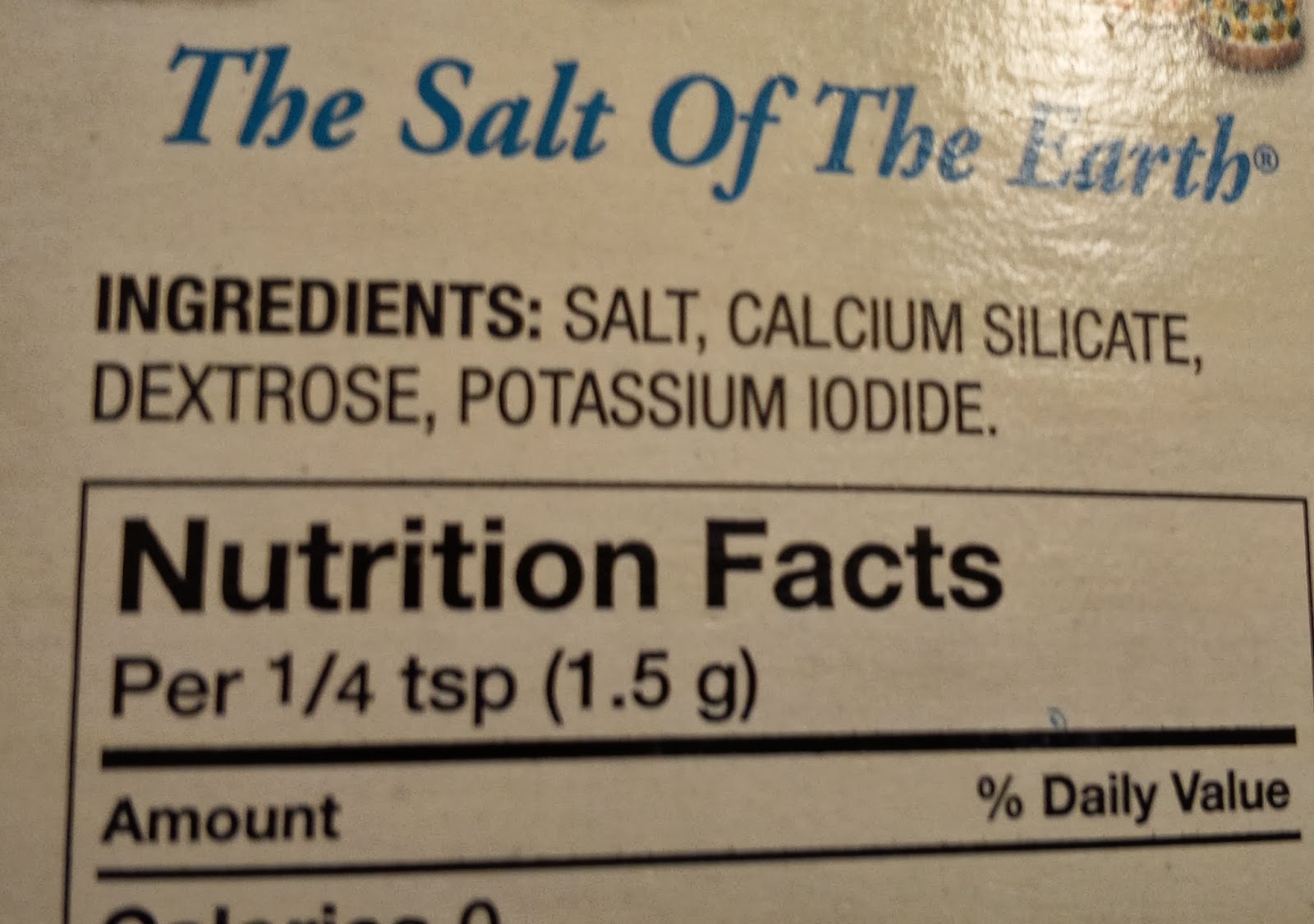 |
| Dextrose is a chemical term for glucose. Sugar. |
Obviously when your salt has sugar, your body's more than a little confused and you're eating something very unnatural. The general goal of someone who wants to be healthy should be to eat as close to a food's traditional form as possible, meaning they'd opt for a steak, which is just a hunk of muscle, instead of a hot dog made of mysterious beef parts mixed with chemicals and wrapped in plastic. Seasonings should be looked at the same way. If you went down to the beach, grabbed a cup of seawater, and waited for the liquid to evaporate, you'd be left with a cup of probably grey and black chunky salt. Believe it or not, this stuff is totally edible (although it's not a great idea, since our oceans have pollution problems). This is natural salt, the way it's been mined for centuries. It's infused, like a good tea, with minerals like magnesium, potassium, and calcium. A good natural salt can have as many as 85 different trace minerals in it. The chemical table salt we're all used to, by contrast, is bleached white, has all the minerals sucked out of it, has to have iodine put back in to protect midwesterners from goiter, and it's so over-purified that it bypasses every toll booth in our bodies and therefore screws us right up.
 If you're going to eat salt - and we all should, in small doses - I highly, highly suggest you invest in a lovely sea or rock salt. Be mindful - if it's pure white, it's probably just a variation of the sodium chloride table salt we're all used to, labeled as "sea salt" to get in on the health craze because technically speaking, all salt came from the sea at some point. Aim to find yourself a nice off-colour salt, fine ground or chunky. My cupboard personally has some adorable fine pink Himalayan sea salt (said to be the richest in minerals), a rich grey Celtic sea salt, and oak-smoked rock salt from South Africa, which smells like a campfire in November. The added bonus of natural salts is that they've got stronger, deeper tastes, and you therefore need less, and this is coming from someone who salts the crap out of her food. It's important to point out that if you're eating a lot of sugar, whether with your sodium chloride, in candy, or as simple carbohydrates, you're probably going to crave salt like a boss to counteract all the sweetness. Cutting down on sugar means you'll need less salt, and if you're eating a healthy, un-stripped salt, you'll be getting essential minerals along with your meal instead of heart problems. Win-win-win.
In summery:
1) Simple carbohydrates are sugar. While our bodies do need sugars to function, they run best on complex carbohydrates that digest slower and give us a little boost of protein. If you're like me and eat bread and pasta all the time, consider switching up for more brown rice and buckwheat to balance yourself out. For the record, granola and oatmeal are simple carbs doused in sugar. Avoid them.
2) Your table salt has sugar in it. It's completely devoid of nutrients and you need shit-tons to make anything taste good. Spoil yourself with a colourful, mineral-rich sea or rock salt and experience both amazing new tastes and health benefits that will protect (in reasonable amounts) instead of harm your heart.

3) Although we all hate to hear it, vegetarians and vegans need to be mindful of their protein intake. It's very possible to be totally healthy on a plant-based diet, but us lazy meat-avoiders have to be careful. If you're like me and don't particularly care to eat beans every day, make sure you're eating lots of whole grains and nuts. If you're also like me and can't really afford/keep forgetting to buy nuts, or are getting really deficient in this important macro-nutrient, consider getting a hemp or plant-based protein powder.
4) Mr Atkins' program is dangerous and dumb. Your body needs fat, carbs, and protein. Give it good quality and reasonable amounts of all three, exercise a little, and stress less, and you won't have to worry about your weight.
5) Food journalism isn't a good long-term habit, I personally think, but it's not a bad idea to log your eating habits for a week or so and then critically look them over - do you eat a lot of sugar? Simple carbs? Salt? Are you stressed out? Do you poop? Are you eating late at night? Take responsibility for your own health. I'll be seeing a naturopath later this month who can help me out with the specifics of my protein deficiency and organize some better eating habits, but in the meantime, I know what I basically need to fix. It's no good waiting for someone else to take care of you; you're the best specialist you've got.
In health,
- Leah


