Showing posts with label farm. Show all posts

10/07/2013

The Autumn Squash Challenge Round #2

OR
Pumpkin Pureé and Popped Amaranth

To be honest, I've never been a huge fan of Halloween, which is funny, because I make costumes as a hobby. But there's a stark difference between coming up with something clever and cheap (Glow stick stick-men! Static cling! Two peas in a pod!) for a one night dance and spending months weeping and freaking out over making a physical outfit to match the often unreasonable proportions and attributes of a cartoon. Anyone who's ever been in the situation of a cosplayer at work or watched one of those "Shit Cosplayers Say" videos is well aware of how out of hand this hobby can get. Budgets are blown, toxic chemicals are inhaled, too-tight wigs are suffered. It's a lot like the kind of stuff models go though, I imagine. There's pain, discomfort, and hunger suffered for beauty - I once went a week before a convention eating nothing but raisin bread with margarine because we were too busy sewing to buy food.

Maybe it's because I'm introverted, or because I've always been bad at making Halloween costumes that were anything other than stereotypical (cat! witch! another cat!), but this end of October holiday just didn't hold much for me after I wasn't allowed to go candy-collecting anymore. My mother, be it out of love or actual lack of money, made the Halloween costumes my sister and I wore every year when we were children, with the patience of a saint and mega creativity. We may not have been as fancy as the other kids in school with their store-bought princess dresses, but I had custom-made butterfly wings that could probably have concussed someone, and my nine-year-old sister was the best sheet of leopard-print roadkill anyone had ever seen. We were proud of our hard work. Halloween has its benefits, therefore: I've gained an obsession-level love for the construction of costumes thanks to Mom, a good bunch of ingenuity genes, and a fondness for stabbing pointy things into an unsuspecting vegetable and lighting it up for display (especially when it's designed to mimic my grotesque plastic surgery eye scar).

Let's just say I had the scariest costume ever,
and Spousal Abuse Barbie got extra candy that year.
Most anyone who's celebrated Halloween has at one point or another carved up a Jack o' Lantern. A dear friend of mine once did up about a hundred of them for around his parents' house, both traditional (triangle eyes, jagged mouth) and non (a light-up Pacman and monster pumpkin eating bleeding apples). The two of us rubbed our hands raw pushing knives through their tough skin, but it was a lot of fun, and I got from it seeds that sprouted like weeds in my garden at home and a couple years' worth of fulfillment for my carving quota. Once I'd moved out on my own and felt the desire to carve again, I'd picked up this particular guy in the above photo, but he only lasted a day after he'd been exposed to the heat of our apartment, and then promptly turned fuzzy and blue, so I now know that I can't cut up pumpkins in this building unless I'm cooking them.

Technically speaking, pumpkins are a type of squash, but for some reason get their own considerations by those people who hate zucchini but love pumpkin pie. Go figure. Maybe I'm a purist, spoiled by the first pumpkin pie I'd ever made and tasted in Orillia (directed by GF's recipe, sent via email), but I refuse to cook with canned pumpkin pureé unless I'm forced to. Making my own is stupid easy and ensures I'm getting a local food - if Nova Scotia's good at growing anything in particular, it's apples and winter veggies. Not only is it kind of soothing to roast a pumpkin, as they make your whole house smell autumn-y, but you also get the seeds from them, which you can roast, although you'll have to find instructions somewhere else, because, as my first Autumn Squash Challenged post indicated, I still haven't mastered how to do it yet.

Because I'm lazy and GF's much better at explaining this, I'm going to let her 2010 self do the explaining for how to roast a pie pumpkin (jack o' lanterns are bigger and need more sugar to taste good). While pumpkin smush is good for making pretty much anything involving the season of fall, you're going to want to not do what I did and mix your pumpkin with cinnamon and oatmeal. Sounds good, looks... not good. Tastes okay.

Erm.
WHAT YOU WILL NEED!:
A large serrated knife (a clean handsaw works too)
And ice cream scoop (or a big spoon; I find the scoop is easier, though)
A large pot

PREPARING THE PUMPKIN!

Preheat oven to 350 degrees.

Step 1: Determine if it's a Jack-o-Lantern pumpkin or a pie pumpkin. Pie pumpkins are the smaller, rounder type of pumpkin. Jack-o-lanterns are the big ones. This is important! Trust me!

Step 2: After determining the kind of pumpkin you've got, wash it under warm running water. DON'T USE SOAP.  Just make sure it's all nice and clean. Maybe hug it a few times too. You're about to get very intimate with this pumpkin, so it's okay. 


Step 3: Cut the pumpkin in half. Use your large knife (or handsaw) and use a sawing motion. A serrated knife is better than a smooth one! They both cut the same, but the smooth knife is more likely to slip and hurt you!

Step 4: SCOOP OUT THE GOOEY INSIDES! You wanna get rid of all that stringy, dangly, slimy stuff! BUT SAVE THE SEEDS! Place them in a bowl of water and rub them between your hands. Then pick out the orange bits (throw that away) and drain off the water. Spread them out on a clean towel or paper towel to dry and they're ready to roast. 


Step 5: After the pumpkin is all scooped out, put it into a oven-able container with a lid. Depending on the oven, baking the pumpkin can take 45 minutes to an hour and a half. After the 30 minute mark, check it every fifteen minutes or so and when it's nice and soft. 
 
Step 6: Once it's soft enough it is easy to scoop out the guts with a table spoon.  Use the spoon to gently lift and scoop the cooked pumpkin out of the skin. It should come off the skin pretty easy if it's cooked enough. Sometimes the skin will lift right off with your fingers! Put the pumpkin into a container or big bowl of some sort. If you find that there's a lot of water coming from the pumpkin, let it sit for like... 20-30 minutes and then drain the water out of the container. Otherwise your gloop will be really runny.

Step 7: IT'S TIME TO PUREE THE PUMPKIN! Hand mixer, blender, food processor... What you have there to do it with... PUREE THAT PUMPKIN!

Pureéd pumpkin, as any baker knows, is good for everything this time of year, from pie to muffins to probably spice lattés (but who knows what goes in those). I've got some leftover from the atrocious pumpkin oatmeal I'd made, and it'll probably be turned into some sort of sweet, as they're more reliable and satisfying. I made killer chocolate chip pumpkin muffins last year. Let's aim for that.

In related news, whilst reading Gluten-Free Girl and debating what to do with my pureé, I suddenly decided to make popped amaranth. Anyone up on their health craze reading will recognize amaranth as an ancient grain that comes from an ornamental flower, rich in lysene, an amino acid that's harder to find in plant than animal food. Amaranth seed basically looks like tiny yellow-y styrofoam balls - the ones that pepper your carpet when you break a big piece of foam from the box your microwave came in. It's got a kind of nutty taste, is rather cheap, and can be puffed up like popcorn. 

Let me try to explain how much fun popping amaranth is using a video (which I swear was HD before I uploaded it).


I'd been rather intimidated to try popping this little grain. I'd heard from multiple sources that it was super easy to do, but any recipe that entails "heating a skillet on high" usually has me balking and GF running from the room. But I was apparently having the sort of day where anything is possible if you don't think about it too much, and so before I'd realized what was going on I was throwing seeds in a pan with a spoon and listening to the sizzle of oil-less cooking. The sound popping amaranth makes is rather soothing, to be honest, like a gentle rain. It's also a lot of fun, and way less hard than I'd imagined. Basically, you put a little frying pan on high heat, toss in a couple spoonfuls of amaranth at a time, let them pop and stir until they're all turning a chocolate colour, then throw them in a bowl. You can use it to make homemade granola bars (like I did; just toss a bunch of grains and nuts into a pan with some sticky coating, like honey or molasses), as cereal, or probably to make cookies or something. In any case, it's an adorable food and I'll be finding more ways to include it in my diet.

Popped on the left, raw on the right.
So basically,

1) No recipe for anything especially different today, but now you know how to make your own pumpkin pureé. If I ever get around to making muffins I'll put up instructions.

2) Popped amaranth is super fun and meditative. Plus it's good for you.

Inconclusive and unhelpfully,
- Leah

10/02/2013

The Autumn Squash Challenge Round #1

OR
Stripey Sweet Potato (Delicata) Squash

Source
When I set the book down, closed its back cover (after desperately checking the index pages for more), and resigned myself to its finish, I had to pause a moment to bask in the glow of a good read. I felt girlish and giddy, pink-cheeked and wanting to squeal to my empty apartment, "How romantic!" in tones usually reserved for fluffy animals and babies. I was thrilled and inspired, ready to jump up and start cooking, or grab GF and swing her around in those iconic ways Disney heroes do their princesses. (Unfortunately for me, she was at school.) Shauna James Ahern had written - in a way, I felt, for me, even though I have no food allergies - an entertaining, mouth-watering, touch-your-heart-like-no-chick-flick-could novel entitled Gluten-Free Girl, after her blog. In poetic iterations of her five senses, the author made carrot sound exotic and mushrooms as rich and delightful as candy. I felt warm and comforted while she described her friends at dinner, and I salivated at the mention of tastes that made her moan. I craved meals that made me writhe in delight as so many of hers did. 

Every once in a while I'll decide my life's purpose is to cook. I'll head to the kitchen and start whipping out pasta and vegetables, dousing pans in oil and spices and licking my lips in anticipation for my masterpiece. Folks using everything from artisan stone pits to Easy Bake Ovens for their bread can (and do) laugh at my dismal baking skills, but the cooks of the world will soon realize they're outmatched. I'll be the Iron Chef! I'll throw anything in a pan and make it a meal! GF will start asking me to make supper!

Oh, dreams. How quickly they crumble. Especially the unrealistic ones. I understand the ideas behind cooking, sure: take food, make it yummy. But the process of getting Jimmy the broccoli stalk from point A to point B eludes every neuron of my brain (population 500*), and poor Jimmy ends up in a severe identity crisis somewhere at point A-and-three-quarters. ("Am I a floret or a stem? Sauteéd or fried? Green or black?") GF's palate is too refined for my culinary mistakes, but my meals are okay enough for me to eat. They're just not... good.

Enter the Seaport Farmer's Market. It's a brand new building a couple blocks from here with windmills on the roof and extra large windows to give visitors a panoramic view of our mutilating harbour water and island full of snakes. Stalls filled with artists selling crafts and farmers with food crowd the walls, wares elevated on wooden stands. Endless lines of tourists stand right in the way of where everyone's trying to walk. There're usually fiddlers. It's very Nova Scotian. On the Saturday after payday I'd made my way down, hauling a little red wheelie cart, to get myself some groceries. I'd made a list and had more success than usual; scored inexpensive free-range eggs, a giant head of kale (which I've only just finished, two weeks later), local coloured peppers, and my favourite rainbow carrots. Much to my delight, most of the stalls had some form of pumpkin or gourd lining their shelves, too.

Being as I've got a cold constitution, I can't say I'm not partial to summer weather. I can broil myself in the hot sun for hours, then cool down in five minutes and suffer nothing more than a tan. But there's something about autumn weather that everybody and their mother adores. Be it the Pumpkin Spice Lattés at their favourite coffee shop, the colours of the dying leaves, or the thick-knit sweaters, there's something about this season that calls everyone together for cuddles and complaints about cold mornings. I love everything about the fall season. The air is wet and smells of rotting leaves. The ground is prime real estate for people who love crunching things underfoot. Every bite of food you're offered tastes of cinnamon and nutmeg.

As may be obvious by now, I love food. I especially love heavy, warm, squishy food. If it tastes like a walk in the woods, a pot on a fire, and a dollop of maple syrup, I am there. Before I'd realized what I was doing this Saturday at the market, my little red cart was heavy with squash. I'd grabbed two armfuls of the strange globes, admiring their colours and textures and reading their cooking directions curiously. I forked over six or so dollars for four medium-sized gourds, and decided in that moment that I would become a Squash Iron Chef. Food in general may not be my forté, but I am determined learn how to make delicious, squishy, autumn meals if it kills me. There are so many bajillions of variations of fall veggies, and more of the squash family. There is no reason why I shouldn't be able to learn to make cheap, filling food out of at least one of these buggers. It helps that GF doesn't generally bother with pumpkins and their cousins, so she can't backseat cook.

I come home with a pumpkin and one each of a sweet potato, spaghetti, and butternut squash. Since I'd tried recipes before of the other three, the sweet potato squash was my go-to for trial #1. 


The instructions said just to bake the little stripey guy, so that's what I did. Forty minutes in a casserole dish at three-hundred and something degrees. The only problem was, after it was cooked, I had no idea what to do with it. Such is the conundrum of being a... well, I wouldn't say gourmet, but a food-collector. I cannot resist buying spices on sale or discount vegetables. I've got lots of tastes to work with, but no idea how to use them. So I mixed the squash with lentils and put curry maple pepper (from Sugar Moon Farm) on top. That sounds decent, right?

  
...ta daa? I'd give round one a 2/10. It was edible, for sure, and I guess not bad, but... not good, either. Clearly this is a squash I'll have to revisit a couple of times to really get a good recipe out of. As I understand, delicata squash come in many different sizes and are generally used as ornaments; this guy just fit in the palm of my hand, so I had no leftover meat to work with.

Host Mom and Dad roasting seeds.
Also, I'd tried roasting the seeds. During the Halloween of 2010 my Orillia host family made the most delicious fresh-roasted pumpkin seeds from the Jack o' Lanterns I and their two girls had carved. I really wish I'd paid attention when Host Dad was cooking them, because I can't for the life of me remember the heat setting or amount of time he'd had them in there. We'd nibbled on those throughout the night, and then after Trick or Treating ate tea, fruit, and hot homemade soup while the girls gagged at the ingredient lists of their chocolate bars and chip bags - a far cry from the way my sister and I used to finish our night of costuming.

My attempt at roasting the squash seeds went much the same way as the squash itself. Maybe it's because I had less that a quarter cup of seeds, or had the oven too high, but in any case, four minutes was too long, and although they looked and smelled nice, the seeds were just too far gone to be pleasant to eat. Very chewy and hard to swallow.


Lessons learned:

1) Find a recipe to follow besides what's printed on the squash itself.

2) Cook more seeds at a lower temperature.

Ding, ding!
- Leah

(P.S: I'm sorry this post is a couple days late. I was ill and working on school project over the weekend.)

*This is a joke. The human brain has an estimated 100 million neurons or more.

9/23/2013

The Human Lawnmower: A Grimm Fairytale For Baby Plants

OR
Growing Greens For The Lazy, Cheap, and Yardless

Alfalfa sprout salad
"It was a bright and sunny morning," said the Kalanchoe ominously (or would have if it had vocal chords), "just like this one." The African Violets nodded earnestly in agreement. (They could also have been swaying in the wind - it's hard to tell with Violets.) The Kalanchoe waved his branches as if warding off evil and loomed over the jar before him. Tiny sproutlings quivered in his vision, tightly packed as a yard of clover. 
"Little sprouts like you sat her not long ago... but that day they disappeared, and I never saw them again."
"What happened to them?!" shouted one of the taller seedlings, leaning forward. The Kalanchoe eyed him pitifully, noting the flush of chlorophyll in his newly formed leaves and knowing the same fate was to befall him soon. The table began to shake as monster footsteps drew near.
"The Sprout Eater."

Has anyone noticed how short lettuce season is? I mean, if you shop at a grocery store or eat other salad greens more resilient to cold then probably not, but the natural Canadian season for lettuce is only a few months long. We hardly start enjoying fruit salads before it's on to the cob salads and then pumpkin and whoops it's snowing you missed it. From the first of September this year our temperatures took a nosedive and parts of the country have already experienced frost and snow. Poor, gentle lettuce doesn't have a hope in Nunatsiavut of surviving very long up here (unless you're Niki Jabbour and make cold frames for the little guys).

When you're a stickler like me and picky about where your grocery store produce comes from, lettuce is basically a no-go in everything but peak season. I've made a rule of not buying anything from outside my country that can be grown in my country. So avocados and citrus fruit are an exotic treat, but berries or veggies from the States are forbidden. It's no 100-mile diet, but it's a small reduction in my carbon footprint that's not hard to maintain. Even GF's on board with it. The warm fuzzies of buying "local" turn into a pain in the butt, though, when I really crave something I can't get, like lettuce in the winter. It's all from California, and generally looks like hell (sorry).

Sprouted alfalfa seeds
Enter the horrific sprout-eater story. If that didn't make a crazy, "I only eat food that fell from the tree," fruititarian out of someone I'll be surprised. GF was actually alarmed when she realized what I'd become. I've been growing baby plants, letting them think their life's adventure was just beginning, then eating them by the bowlful just as they turned green. I've become an infant plant murderer.

Like my mother, many of you may have alarm bells ringing in your heads at the word "sprouts". Images of yellowy, bean-like plants in plastic containers with warning of E. coli may be flashing in front of your mind's eye. A boy in my elementary school, bless him, used to eat those pale plants by the handful, and my fellow students used to tease him endlessly about them (while eating their oh-so-healthy Lunchables). His mother was onto something, though, and obviously ahead of her time in the holistic world, if not quite on the right track. I urge anyone wasting money on these supermarket bean sprouts to hear me out, and anyone unfamiliar with all this baby plant consumption to relax about all the germs.

Sprouts are the beautiful little beginnings of edible plants, and they are both delicious and cheap. They're made by soaking raw seeds, nuts, or grains periodically in water over a few days and lettings the baby plants hidden inside those shells to start to grow before mercilessly snatching away their life once they're a few hours/days old. Sprouts are hailed for being full of enzymes, antioxidants, and amazing, life-saving chlorophyll (plant blood, rich with magnesium). They are by far one of the most raw, pure sources of sunlight we can pump into our bodies, and they make a lovely (if a bit different) replacement for lettuce in a salad.

This being said, a supermarket sprout is pale (although those kind of sprouts are anyway), dry, and probably a few weeks dead before you buy them, therefore those lovely perks that make sprout-eating worthwhile are completely null and void in those yellow bean sticks. Plus they've been sitting around in stagnant water for a while, so E. coli has time to multiply. Yum yum. Sprouting at home ensures you're getting the benefits of living, germ-free plants, while saving money and experiencing a bit of variety, should you so choose. It's ridiculously easy to grow sprouts - you need no special equipment, no particular heat, no parental supervision, and no yard or balcony. You don't even need a south-facing window. 

Sunflower seeds, pepitas, buckwheat, chia,
mung beans, adzuki beans, spelt, alfalfa,
teff, amaranth
(All bought for UNDER $10)
As a general rule, you can sprout all seeds, most nuts, lentils, chickpeas, adzuki and mung beans. You can find specifications of what sprouts best and how long they need to do so (like on Leanne Vogul's sprout FAQ) all over the internet, but I mostly just avoid large beans and eat'm when they're green.

A good starting bean for sprouting are lentils. To be honest, I've never actually sprouted lentils, but where most other sprout seeds can be hard to find outside of a health or specialty store, lentils (or chickpeas) can be bought dry in bags at the local supermarket. Grab a small handful of beans (they're going to expand to about 8x their size) and dump them in a glass jar. Most people use mason jars, but I've got washed out salsa containers, and a glass cup would be okay, too. A clear plastic cup might work, but I haven't tried. You want something that will allow the seeds light and create a little greenhouse effect. Over the lip of the jar you'll need some sort of mesh to hold the beans in but filter water out. I use some muslin cloth I found in the sewing scraps. Many people use a plastic or metal wire screen. Again, your call. Stretch your barrier over the top of the jar and grab something to hold it in place - I use rubber bands or hair elastics. Fill your jar with water and let your beans soak for a while. Like with the ingredients in a stock, the bigger your seeds, the longer you should soak them. Alfalfa seeds take four or so hours, lentils maybe five or six. I usually just let them go until the water looks cloudy. Sometimes overnight.

Soaking alfalfa seeds
Once your seeds have had a good bath, drain all the water, rinse them, then find a place where you can sit them to dip-dry. The water needs to seep out and the sprouts need to breathe, so don't put them face down on a plate or anything. I put mine on the lip of a soup cup at an angle, but you can flip yours fully upside down as long as they're on a dish drainer or something equally elevated and holey. They don't need to be in the sun right away - for mung beans, some folks suggest they should never be in light. You can let them grow on your kitchen counter, if you want. Just poke them in the sun during their last day so they start making that beautiful chlorophyll and turn green.

Now comes the easy part. Let the sprouts do their thing. Rinse them at least once a day (twice, once in the morning and once at night, is usually recommended, but ain't nobody got time for that) and eat them when they've got decently long tails on them or are turning green (again, the amount of time you let them grow for depends on the type of plant; consult the Google). Lentils should be eaten before they grow leaves. You can eat the seed husks or rinse them off. It's totally personal preference. Use them on/as salad, top a burger, dehydrate them and use them in bread, throw some in a casserole, whatever. Generally you should avoid cooking sprouts, though, because putting any sort of baby in an oven is guaranteed to kill off anything you like about them.

Spelt and adzuki beans sprouting
(Kalanchoe in the background)
Important things to note!

1) As a VERY IMPORTANT NOTE, you can sprout kidney beans (and it's cousins, like navy, pinto, and black beans), but you HAVE TO COOK THEM. This does kill off enzymes, but eating big beans raw, especially kidney beans, will make you violently ill. They're poisonous. Sprouting and then cooking beans of any sort, though, makes them much easier for our bodies to digest by turning their complex carbohydrates into simpler ones and making their nutrients more bio-available. If you're prone to gas when you eat beans, sprouting them beforehand will more than likely prevent that. 

2) Always get your sprout seeds from a food store, NOT a gardening store, where they may be cheaper but coated in pesticides/herbicides. Even if they're organic, it's a much safer bet to find some at food-grade. 

3) As anyone who clicked on Leanne Vogul's sprout FAQ link may have noticed, some people drain their sprout jars and then leave them right side up to grow. You can do this too, but I suggest the face-down method because it ensures there's no water pooling at the bottom of your container for mold to grow in.

Jar-sprouted teff. Bad idea.
4) Some very small or gelatinous seeds, like teff or chia, can't really be grown in jars. For those you need to use the toss-them-on-a-plate-and-attack-them-with-a-spray-bottle method, which I haven't tried. I did try doing the teff-in-a-jar method, though, and it just got moldy and attracted fruit flies. Alfalfa seeds are probably the smallest you should go with jar sprouting.

5) I use the green-tinted water the sprouts drip off to water my other plants, and they seem to love it. Good (cannibalistic?) sprout food for all!

Sun-filled and growing,
- Leah

8/30/2013

What's That, Lassie? Jimmy Fell Into A Well?


OR
How Wild Blackberries Almost Got Me Killed

Once upon a time, a jealous witch who didn't get invited to the baby shower for GF teamed up with a couple of errant gods, a swarm of malicious gremlins from the 80's, an amazonian witch doctor (no relation) and that voodoo guy from The Princess and The Frog and cursed her family line. Poor GF grew up as the most unlucky woman in the world, and has a thousand and one stories detailing how she dislocated both her shoulders with a glass coffee table, broke both her ankles by jumping, permanently damaged her knee by tripping over a cat, or became on of the two people in Halifax to get E. coli poisoning. Since we began living together in 2011 she's been to the hospital no less than twelve times. Murphy's Law was written for the girl - "Whatever can go wrong will go wrong, and at the worst possible moment," - with a special addition of "to me."

One of the tamer stories entails GF as a kid. She fell through a friend's deck. Young GF was a few inches away from breaking her legs and came home with quite a few bruises and a couple of deep scars (frighteningly close to her femoral artery) which are still very obvious today.

Let's just say my trip to the Kempt Shore this weekend made that story a bit less of a novelty and much more imaginable.

The field at my second cousin's cottage. (This is actually a
photo from two years ago. Sorry.)
They say if you don't like the weather in Nova Scotia, you should wait five minutes. Chances are it'll change. This past Saturday my dad and I had taken my grandmother out to see her niece and sister-in-law in the Valley, and although the day started in torrential rain, by the time we arrived at their lovely old cottage the skies had turned blue and I was dying of heatstroke in identically-coloured jeans. My second cousin (Dad's cousin and my Nanny's niece - it's all very confusing to keep track of, despite this being the small side of my family) was thrilled to announce their field had wild blueberries in it, which they had been collecting to make jam.

Anyone who's been reading this blog since the beginning (a whole five posts ago) knows that:

A) I compulsively collect food

B) I bought a shit-ton of blueberries from a U-Pick less than two weeks ago

These in mind, you'll understand why A could not say no to baking in the hot sun to pick wild berries (totally different from high-bush) and why B therefore was disregarded. I knew, however, that GF would tease me for bringing home more blueberries (which she dislikes), so I decided I'd delve into the just-ripening patch of blackberries (which she adores) near the cottage to keep her exasperation at bay.

It's understandable, considering that everyone except my dad and I were over 60 years old, that my second cousin and grandmother couldn't get anything more than a half-pint of berries. There were hardly any ripe suckers on the outside of the blackberry bush. But having spent hours as a child hunting out and eating all sorts of wild berries, and being as spry as I am, I knew what I had to do: I got right down on he ground and crawled into the centre of the blackberry bush. I collected armfuls of scratches, a sunburn, and a few upset spiders' webs (sorry), but ended up two full pints of the little gems. Being as I don't particularly care from blackberries, it was either unconditional love for GF or a rush of childhood nostalgia that made me willing to grass stain the crap out of my jeans. I made sure I'd collected every non-red berry on that plant, and was just doing my final lap around the bush when it happened.

Wild blueberries!
The giant cast-iron faucet sticking out of the ground should have been an indication, but I can be dumb as a post when I'm distracted by food. There was a wooden pallet lying on the ground next to the blackberry bush, which the faucet was coming out of. I stepped on it, and moved forward in search of the last few berries. Suddenly, I wasn't standing up.

Being as there was a barking collie next door, if I had fallen in, I'm sure jokes would have been made. I had broken through a couple rotten boards on the pallet and was sitting with one leg hip-deep in an old well. I could see a couple of flat rocks siding the hole in the ground, but below my foot was just darkness. I have no idea how far down it went, but had the boards given way I would have at least broken my legs.

As it was, I very carefully crab-walked my way out and off the boards, gathered my spilled berries, and hightailed it out of there. Food was no longer especially interesting.

The moral of this story:

1) Always take free food, even if you already have lots of it - but only if you're going to use it. Hoarding food you won't eat only takes it away from someone who could.

2) Don't play near old wells! To people who own them: please check to make sure they're still holding up! PLEASE.

Bark, bark!
- Leah

8/26/2013

Who Invited The Herbivore?

OR
A U-Pick Adventure and The Vegetarian Who Doesn't Preach


Oxford, Nova Scotia, calls itself the Blueberry Capital of the World. It's got fields and fields of blueberry farms and a blueberry festival, and a giant, slightly horrifying metal blueberry statue at the first rest stop off the highway, complete with a Tim Hortons. 

"Oh heeeeeeeeey."
I was nowhere near Oxford, though. That was useless information for your next trivia competition at the pub. Now you know the answer, should anyone quiz you on the obscure and rather sad slogans of towns in my province.

Bedford: A Traditional Stopping Place
Stewiacke: Halfway Between The North Pole and The Equator
Truro: The Hub of Nova Scotia

Two weeks ago we went to my new favourite place in the Valley, Dempsey Corner Orchards. GF and I went last year, but too late in the season for anything really good. This time we brought friends and sunscreen and plaid shirts (lesbo chic) and completely forgot to pack a lunch. Oops.

We got our hands filthy and fed screaming kids and pulled a really heavy wagon back and forth in the blazing summer sun for hours - for fun

Dempsey is a gorgeous U-Pick farm in Aylesford, Nova Scotia. As the name implies, they grow the food, and you pick it off the trees/bushes or dig it out of the ground. Not only are the workers super nice and the farm full of variety and the animals adorable, but the owner is a riot. She appeared during our U-Pick 101 session, draped herself all over our teacher, wailed about how she'd been missing her since a whole day ago, then offered us a pregnant cat. She also tried to sell us a book by asking, "Do you like to read? Do you poop? If you keep it in the bathroom this book is perfect for extended stays." My kind of woman.

I mentioned before that I generally don't get to eat fruit because I can't afford to. Despite Oxford being only about an hour away, blueberries can cost anywhere from $4-$7 per two handfuls. Just about a cup of berries hardly feeds one person, let alone two for two weeks. For a poor almost-student, fruit is just out of the question. U-Pick fruit is the exception to this rule. Not only did I score enough blueberries to satisfy me for probably a good chunk of the winter (six boxes), but I got them organic and for $2.50 each.

GF also got a huge kick out of digging white potatoes, and we came home with probably three or four pounds for less than $3. There's absolute benefit to buying in bulk and doing the harvesting work yourself. Provided we can keep them at an optimal temperature (Warm Apartment Hates Potatoes: A Memoir), we'll have three months worth of food for $18.

On a related note, we also picked up 8 kilos (16 pounds) of rice for $15 from the grocery store. Rice and Lentils are a very cheap, base staple for really tough times that everyone should be aware of - it's much healthier and less expensive than, say, Hamburger Helper (and requires less attention to cook).

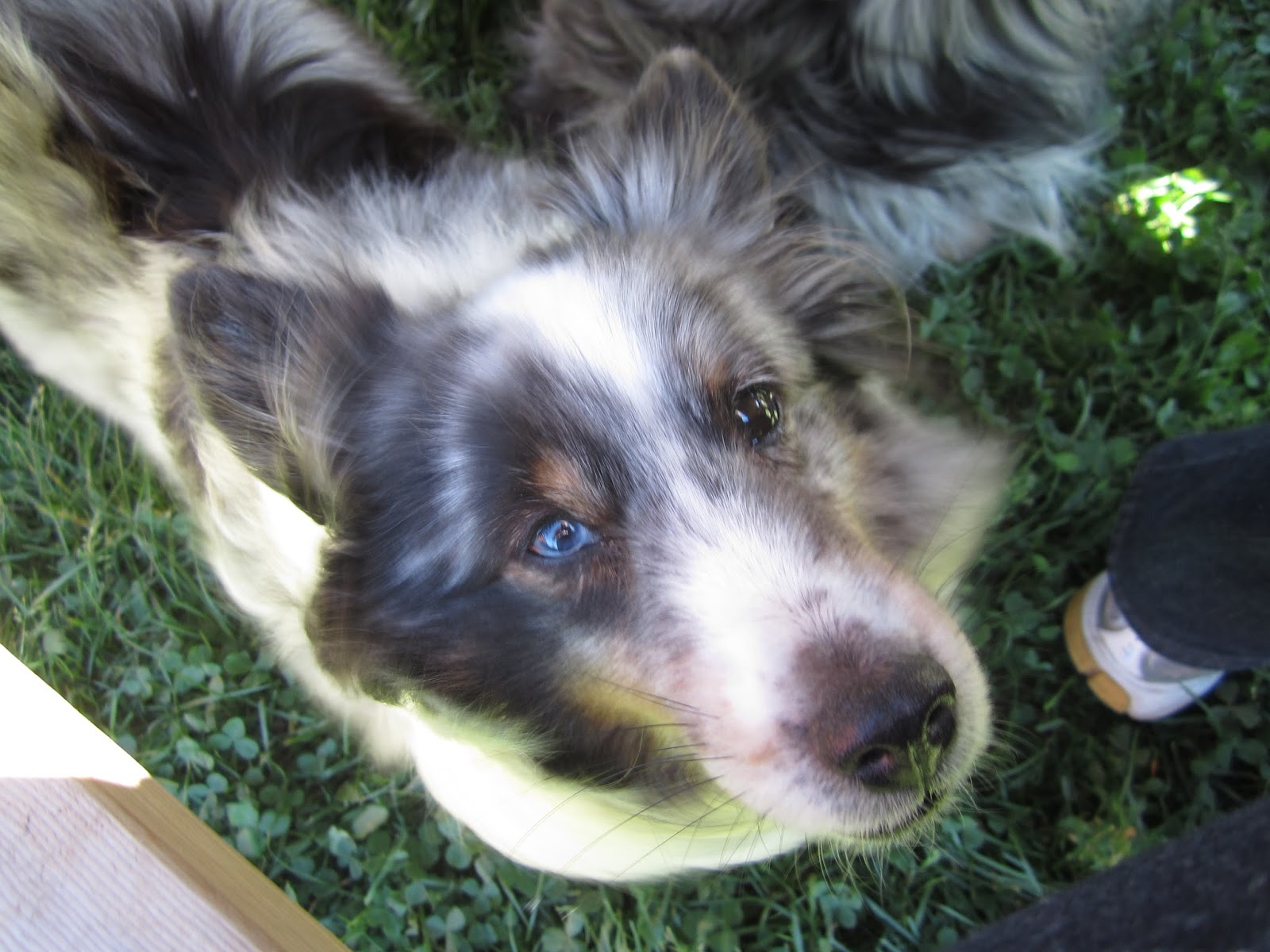
"Little Dog" begging me with his beautiful
two-coloured eyes to feed him more cookie.
Dempsey has a beautiful big yard besides the gardens that kids can play in. Around it are pens full of farm animals, enjoying their day-to-day life and so used to attention that the goats, pigs, and baby cow (named "Daisy" - can you believe that?) will come running when someone approaches, screaming for affection (and probably food). There were rabbits, ducklings, two hilarious piggies, two breeds of hen and a rooster, sheep, goats, and the cow, plus four absolutely precious old dogs, whom I referred to as "Fluffy Dog", "Fluffy Puppy", "Dead Dog" (he laid around so still), and "Little Dog" and fed under a picnic table. I had my hands all over any animal that would stay still long enough (pig noses feel so weird!) and had to help get Daisy the calf into the goat pen without the goats escaping, during which time I had my fingers licked and became a cow whisperer.

For the last year or so I've gone from a relaxed vegetarian to more of a flexitarian (someone who generally avoids meat but won't disregard it completely), but it struck me when I was feeding Daisy how like the dogs she was. She had such gorgeous big brown eyes and was so dainty and polite as she took grass from my hand. I think I fell in love with her and her shyness and little hooves, and it kind of hit me while I was petting her neck that I've eaten bigger versions of her. That thought upset me the whole drive back to the big city.

Everyone knows how food animals are treated in developed countries. I don't have to quote any hippie books or activist websites on the horrors of feedlots and slaughterhouses. It's sick. But we don't make the connection of hamburger = tortured cow because we're not seeing it daily, and because we much prefer the delusion of the happy Dempsey-esque farm life for Bessie or Daisy the Former. I've let myself slip into that delusion, going, "I'll buy humane, grass-fed, local beef when I have the money, but I can only afford regular stuff right now." Really, I should be taking responsibility for the practice I'm promoting with my appetite, and just avoid eating those animals who have as much personality (if not as much brainpower) as my childhood dog. I wouldn't want my boy or Fluffy Puppy in a slaughterhouse.

(I will, however, continue making broth from animal bones, because GF does eat meat, and I will not waste food.)

So the herbivore has returned. Admittedly, I've gotten used to eating meat now, so stopping is a bit of a challenge. But I'm determined, for both the sake of the baby cows in the world and for my own health. Next stop: hummus.

Things to pick from this:

1) Buying in bulk is almost always cheaper than pre-packaged. Picking your own food lowers the cost even more. If you can get to a U-Pick before winter, do so, and stock up!

2) Go to Dempsey Corner Orchards, or, if you're too far away, check out their quirky Facebook page.

3) What you eat is your business. Take a second to reflect on your business expenses. Could you eat less of something and splurge on the more humane/antibiotic-free/local version? Would it save you money? Could you consider limiting what meats you eat? Could you be passionate about your food choices without criticizing others for theirs? Let's all be open-minded!

4) Dogs love carrots.

With love,
- Leah